Class 3 (Special Signals)
Periodic signals
The fundamental period
For a continuous-time signal, the fundamental period is the smallest $T_0$ value such that $$x(t) = x(t+m T_0)$$ for any integer value $m$.
For a discrete-time signal, the fundamental period is the smallest $N_0$ value such that $$x[n] = x[n+m N_0]$$ for any integer value of $m$.
The fundamental frequency
The reciprocal of the fundamental $$ f_0 = 1/T_0 \quad \textrm{or} \quad f_0 = 1/N_0 $$ is known as the fundamental frequency of the signal.

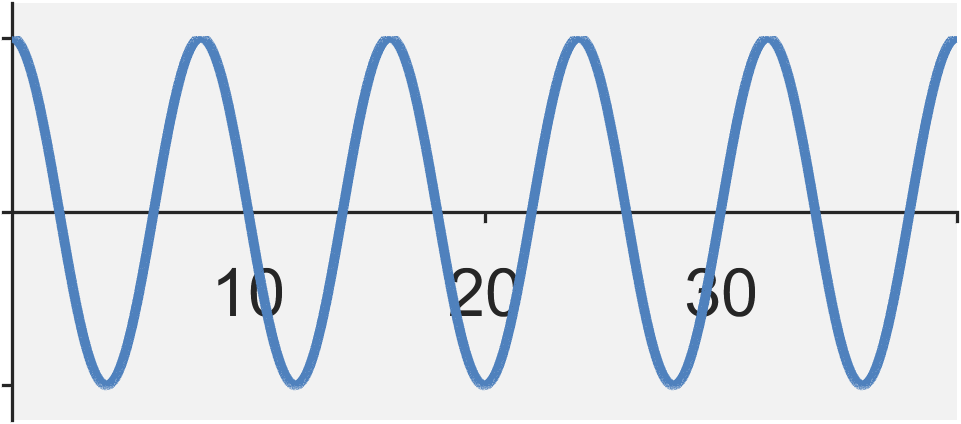
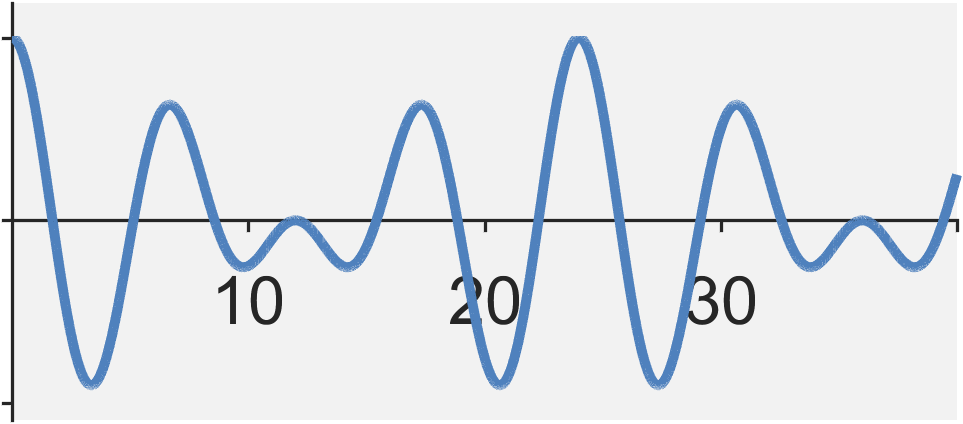
(least common multiple of 6 and 8)
Sums of periodic signals
For a single periodic signal, the fundamental period is the smallest period in that signal. For example, the fundamental period of $$x(t) = \cos(2 \pi t)$$ is $T_0 = 1$.
For a sum of periodic signals $$x(t) = x_1(t) + x_2(t) + x_3(t) + \ldots,$$ the fundamental period is a little more complicated. Assume $T_1, T_2, T_3, \ldots$ are the fundamental periods for Assume $x_1(t), x_2(t), x_3(t), \ldots$. The fundamental period is the first smallest interval $T_0$ in which every signal repeats.
Computing the fundamental period of a sum
From periods
The fundamental period $T_0$ of $x_1(t)+x_2(t)+x_3(t)+\ldots$ is the least common multiple of the individual periods $T_1, T_2, T_3, \ldots$.
From frequencies
The fundamental frequency $F_0$ of $x_1(t)+x_2(t)+x_3(t)+\ldots$ is the greatest common divisor of the individual frequencies $f_1, f_2, f_3, \ldots$. The fundamental period is then the reciprocal of the fundamental frequency.
Additional Resources
- From this course
- From Richard Baraniuk's open textbook
- Common Discrete Time Signals
- Continuous Time Complex Exponential
- Discrete Time Complex Exponential